Meet the fastest growing Creator on Linkedin
Lara Acosta's 2026 Playbook
Hey team!
Hope you’re having a great week.
Recently I’ve been trying to grow on Linkedin.
I was getting a few really good Clients finding me on there and so naturally, I wanted to reach more of them.
Apparently its where people doom scroll whilst pretending to be at work?
A good place to reach new customers then!
Anyway…
I hit up my network for the playbook.
And landed on my friend Lara Acosta.
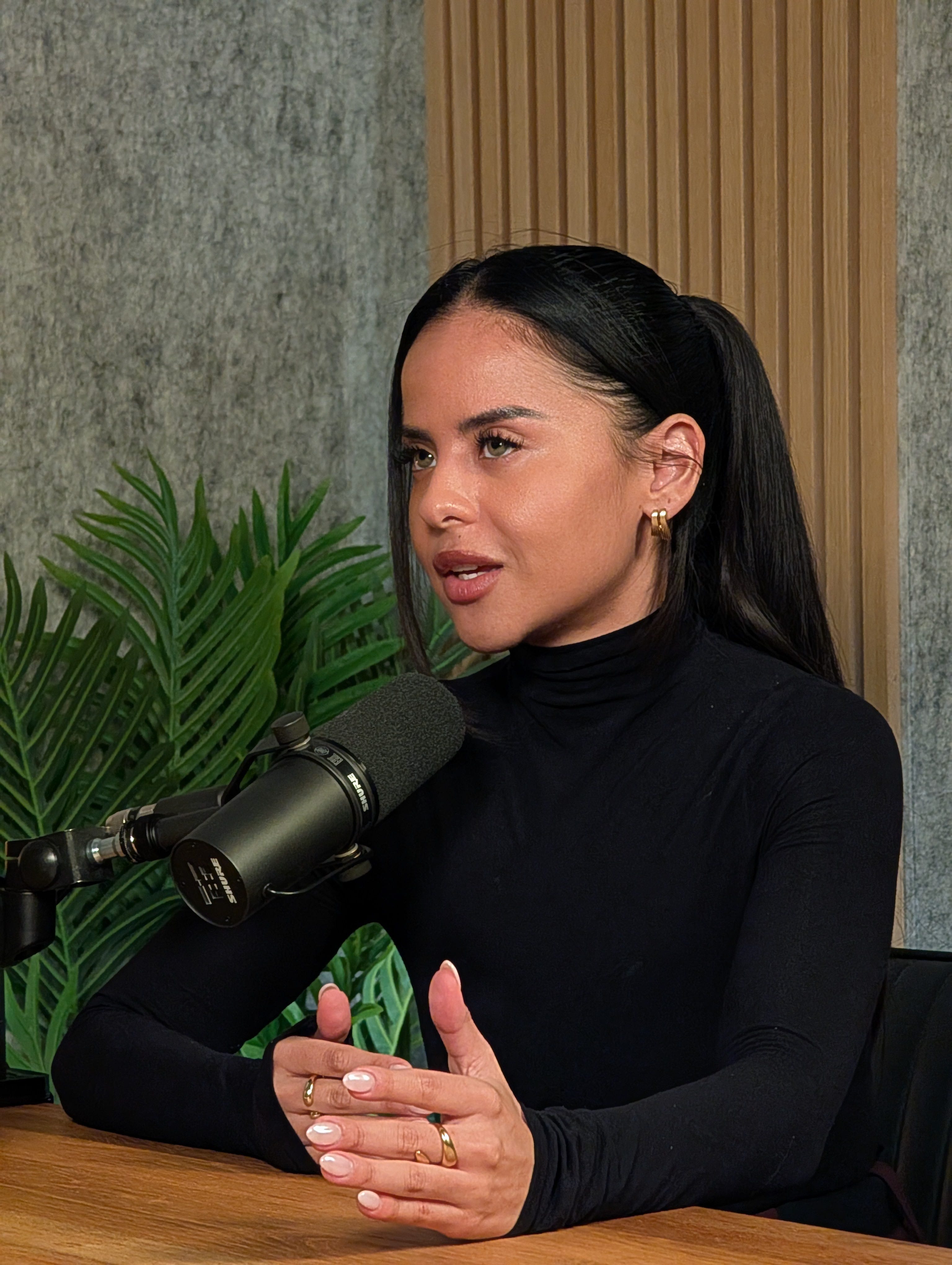
She’s one of the fastest-growing Creators on the platform:
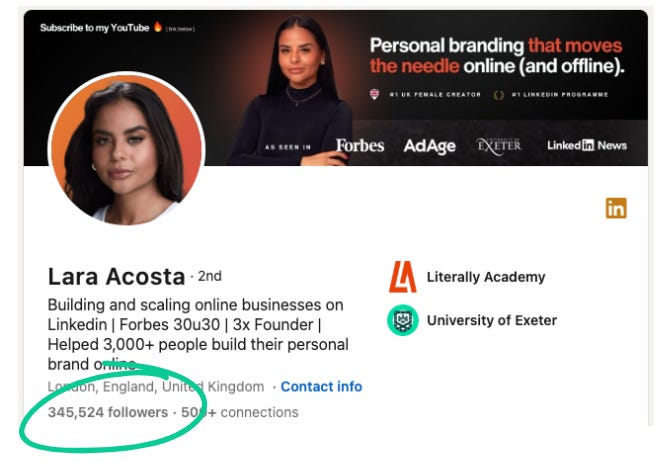
320,000 followers from zero in 3 years
50,000+ on her email list
Linkedin powers her 7 figure education and SaaS businesses
every client comes through her content
She’s legit:
So I asked Lara:
“If I want to grow my personal brand on Linkedin and reach more of my ideal customers - what should I do?”
She gave me her playbook:
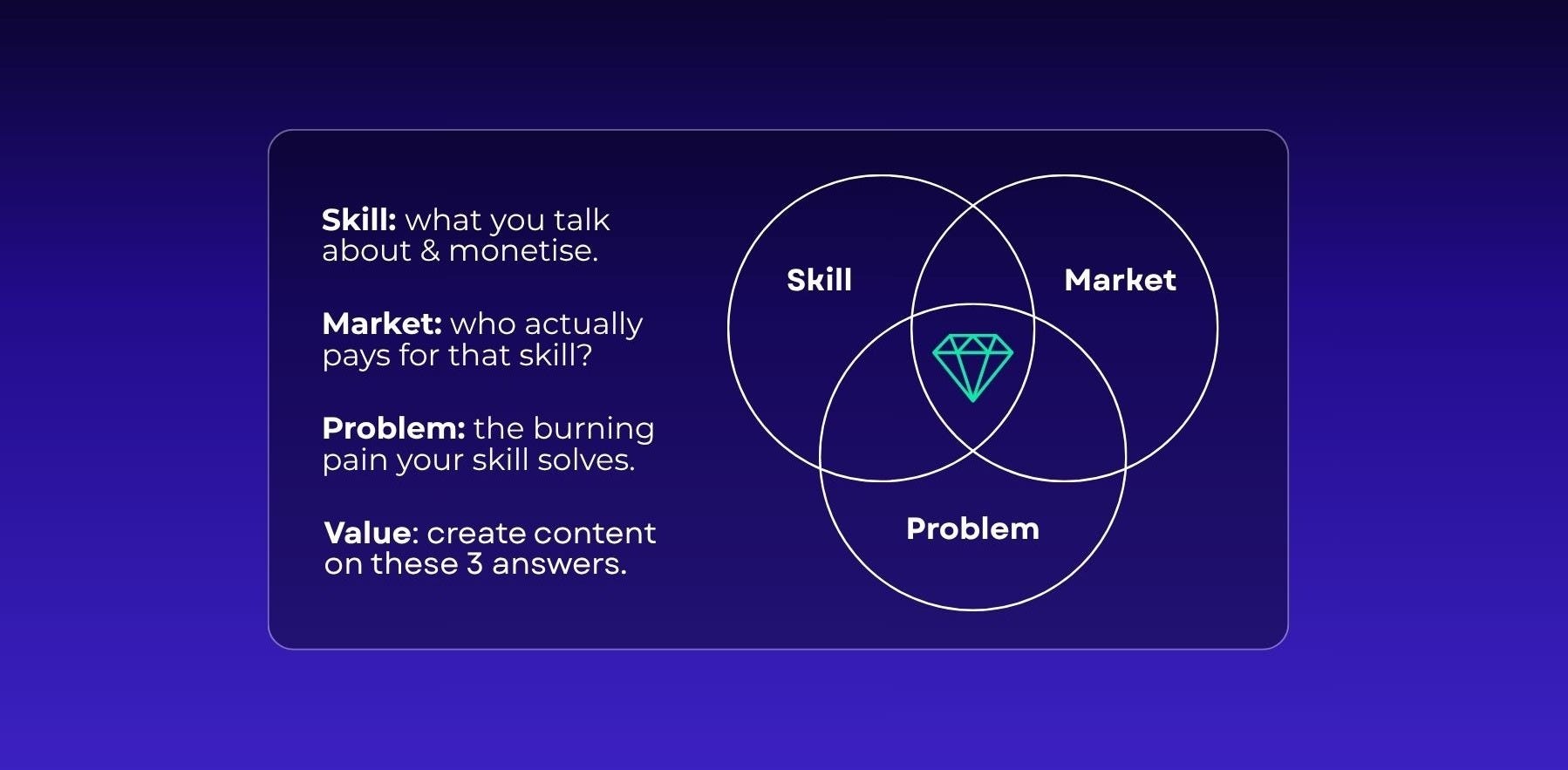
1/ Start With The SMPV Framework
Lara won’t let anyone near a content calendar until this is nailed down.
“The reason most people aren’t growing on LinkedIn?
They’re consistent.
They’re consistently bad!”
Most people post lifestyle, hobbies, business and selfies in the same week.
The algorithm has no idea who you are:
Pin one skill
Pick one market
Solve one problem
Every post lives inside that box.
2/ The 4-3-2-1 Content Strategy
Once your SMPV is locked, Lara has a system for what to actually post.
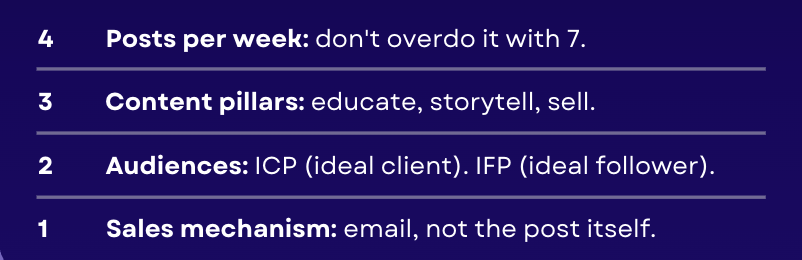
The key thing nobody talks about: you have two audiences, not one.
ICP – Ideal Client Persona
The person who buys from you
IFP – Ideal Follower Persona.
The person who doesn’t buy – but champions you
They like
They comment
They share
They’re the reason the algorithm starts paying attention
Nobody talks about the IFP.
Everyone optimises for the ICP.
Optimise only for ICP and you sound like every other “founder talking to founders”.
Write for both?
And your reach opens right up.
This is principle I see time and time again.
Go a bit broader with your topics to get the reach needed to find more of your actual buyers.
Ok, so how do we write posts?
3/ The SLAY Storytelling Format
Lara uses her signature framework:
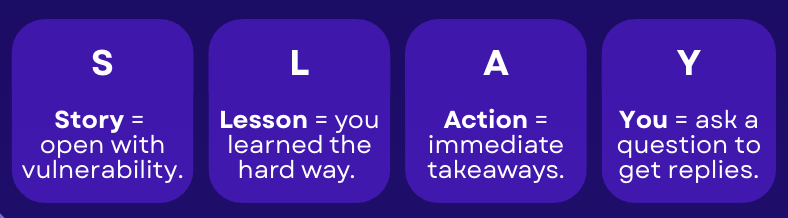
This is the format that’s been responsible for nearly every viral post she’s written.
“Most creators regurgitate frameworks because they work but they don’t understand why they work.”
This is how it works:
Story builds connection
Lesson builds authority
Action gives the reader impact
The question gets them commenting
Every storytelling post should follow this arc.
4/ Storytelling > Educating
Why should we storytell?
“Storytelling is the single most powerful format on LinkedIn right now. People say it’s educational content. I disagree.”
Four years of data back that up for Lara.
An educational post only lands with people who already know they’ve got the problem.
A story lands with everyone.
Lara gave me an example hook I could use: “Broke in 2021, interviewing top founders by 2026”
No pitch about podcasting.
Just a hook that pulls in a stranger who’s never heard of her.
“People don’t trust people they don’t like.”
Storytelling is how you get liked fast.
Then you can educate them on their problems and your solution.
But story gets them reading!
5/ Calls To Engage > Calls To Action
This one will change your engagement overnight.
Stop telling people to like, follow or repost.
“Follow me for more” doesn’t work!
People follow you when you’re useful, not when you ask!
Lara only uses CTAs on her one weekly sales post.
For everything else?
She uses “Calls to Engage”.
Just a question.
“What guest would you like next?”
“What’s the hardest part of growing your audience?”
Why?
Questions get comments
Comments power the algorithm
The algorithm gets you seen
Stop selling at the end of every post.
Start asking.
6/ Profile In 2026 Is Different - change this now!
A leaked LinkedIn engineering paper called “360 Brew” changed the platform.
Old LinkedIn?
Multiple algorithms
One ranking for posts
One ranking for profile
One ranking for comments
New LinkedIn?
One algorithm
Ranking everything together
What does this mean for you?
Your profile is now THE most important thing on LinkedIn.
If your headline says “Founder | Speaker | Coach | Mum | Ironman”
The algorithm has no idea who to send you to.
If it says “I help B2B founders build their personal brand on LinkedIn”
The algorithm knows exactly where to put you.
The fix:
Headline: 8 words on the problem you solve
Banner: Social proof, not “click here” (you can’t click a banner)
Featured section: 3 items, free lead magnet, medium tier, paid offer
Copy this:
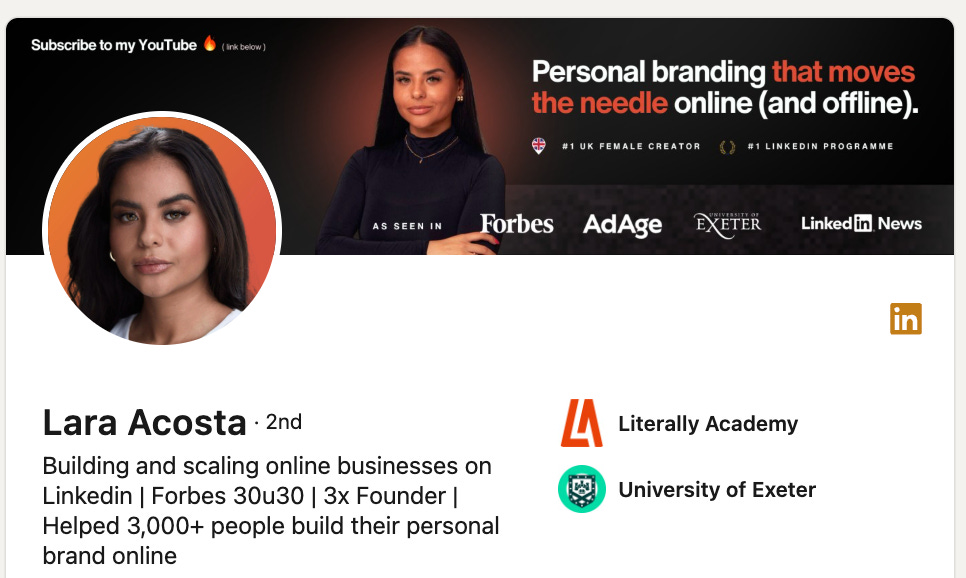
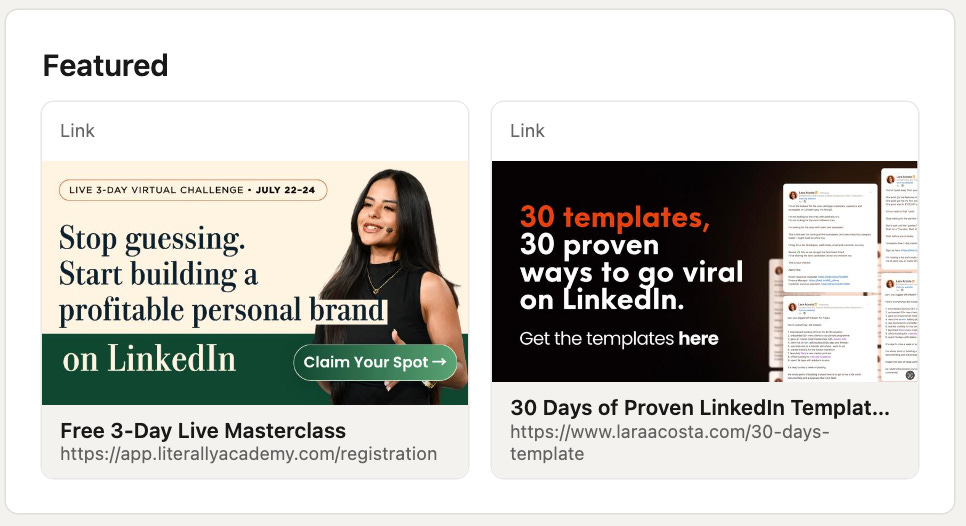
Profile first.
Content second.
I implemented this change and got a crazy result:
The next week a global media company found me by searching ‘podcast expert’ on Linkedin!
I was in their offices having a meeting with their global team 2 week later.
Wild.
All from 1 simple change to my headline.
7/ Don’t Outsource Your Comments
This one was maybe unexpected?
I assumed everyone had a VA replying to comments all day.
But Lara has 320k followers and writes every single post and every single comment herself.
No VA
No AI bot
No “great post 🙏”
Why?
“Some things are not worth scaling.”
“You can post twice a day on LinkedIn. You can comment 100 times. Commenting gives you a lot more visibility than just posting and hoping.”
Her ideal client is reading the comments.
A heartfelt reply on a Steven Bartlett post will get her seen by 1,000 people.
A VA’s “thanks for sharing 🙌” will get her ignored.
She blocks an hour a day for it.
Every day.
You have to reframe your brain around how this is higher leverage than taking a 1 hour meeting with 1 person.
Your comments can be seen by 1,000s of people each day.
They are high impact.
If done properly.
8/ Find Your Content Fit
There’s no winning format.
Only the one that fits you.
Lara and her SaaS co-founder Jake write completely differently.
She’s story-led.
He won’t touch a personal story:“Tt gives him the ick”
Both are winning.
She’s at 320,000 followers, he’s at 190,000.
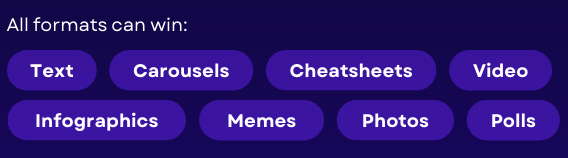
Lara’s rule: test any format for three weeks before deciding it doesn’t work.
Prioritise whatever you can actually produce consistently.
Not whatever looks good on someone else’s profile.
9/ Build A Vertical Business
Maybe my favourite framework of the conversation?
Most founders make the mistake of running horizontal businesses.
They start an agency. Get bored. Launch a CPG brand. Then a side project.
Different audiences. Different funnels. Different brands.
Lara runs a vertical:
Same audience
Same skill
Different entry points
Kleo (99$ SaaS) → Literally Academy ($997 course) → The Known Club ($3k cohort) → 1-to-1 mentorship ($3k/month).
One audience flows through them all.
Stay in your lane.
Build up the price + product ladder that helps your audience.
10/ Email Is The Engine
Lara has 320k followers on LinkedIn.
50k subscribers on email.
70% of her revenue comes from email.
Her advice for founders thinking about starting one?
Don’t start an email list until you’ve mastered LinkedIn first.
Master one platform.
Validate your message.
Then build out your funnel.
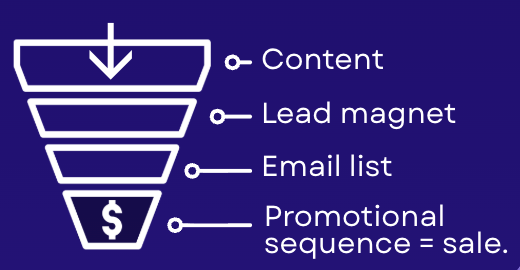
Her welcome sequence:
Email 1: Welcome + free resource
Email 2: Origin story (who the hell are you?)
Email 3: Case study, how you solved this for someone
Email 4: Educational deep-dive
Email 5: Soft sale
Then into regular weekly newsletters.
Ok, that’s a wrap!
There’s plenty more in the full conversation:
Her exact launch email
Her in depth creation process
How she hired her content team
Full episode’s up on YouTube and Spotify.
Let me know what you think.
I read every reply.
Hope you have a great week!
Callum
Maybe you need more than you get in these emails?
Reply and I’ll answer your question
This is a useful breakdown, but I think it attributes too much to the writing alone. I followed Lara from early on and the consistent use of a selfie (which had nothing to do with her post) alongside posts was also part of the strategy. We often analyse copy while ignoring the packaging that gets people to stop scrolling in the first place.
I’ve followed her journey since I joined LinkedIn in feb 2024.
She had all of the ingredients to build on of the strongest brands I have sein on Linkedin.